Acide férulique

[20]
4,02  (TVA incluse)
3,38  (sans TVA)
_ _
Code Taille Prix net Prix total Quantité
M-1377-0.01 10 g
3,38 
4,02 
M-1377-0.25 250 g
32,88 
39,13 
Référence produit D-1377

Description

Acide férulique – Le bouclier photoprotecteur et stabilisateur antioxydant

L’Acide férulique est un puissant antioxydant naturel haute performance, reconnu pour sa capacité à neutraliser les radicaux libres. Il contribue à la protection des structures cellulaires contre le stress oxydatif induit par les rayons UV et la pollution. Au-delà de ses propres bienfaits, l’Acide férulique ajouté aux formules stabilise les vitamines C et E, ainsi que d’autres actifs antioxydants, renforçant ainsi leur capacité à protéger la peau contre le photo-vieillissement.


Ingrédients (INCI) : Acide férulique.


Caractéristiques techniques

  • Origine : Végétale (généralement extraite du riz).
  • Aspect : Poudre cristalline, de couleur blanc cassé à jaunâtre.
  • Solubilité : Insoluble dans l’eau. Soluble dans l’éthanol, dispersible dans le propanediol.
  • Fonction : Antioxydant haute performance, photoprotecteur, agent éclaircissant.
  • Dosage général recommandé : 0,5 % - 1,0 %.

Informations issues de la littérature spécialisée

L’Acide férulique est une molécule de référence dans les études sur les soins de la peau :

  • Neutralisation des radicaux libres : Sa structure chimique lui permet de donner des électrons avec une grande facilité, neutralisant ainsi les radicaux de type superoxyde, hydroxyle et oxyde nitrique.
  • Synergie CE-Ferulic : La littérature spécialisée confirme que l’association de l’Acide férulique avec les vitamines C et E augmente jusqu’à 8 fois la photoprotection intrinsèque de la peau, offrant un bouclier puissant contre les coups de soleil.
  • Inhibition de la mélanogenèse : Des études indiquent un effet de réduction des taches pigmentaires par inhibition de l’activité de la tyrosinase, similaire à celui de l’arbutine, mais via un mécanisme antioxydant.
  • Stabilité de la formule : Il est capable de prévenir l’oxydation rapide de la vitamine C (acide ascorbique), prolongeant ainsi la durée d’efficacité des sérums pour le visage.

Principales propriétés

  • Puissant anti-âge : Prévient la dégradation des fibres de collagène et d’élastine.
  • Renforcement de la photoprotection : Appliqué sous une crème SPF, il maximise la défense contre les rayons UVA et UVB.
  • Unification du teint : Contribue à l’éclat de la peau et à l’atténuation de l’hyperpigmentation.
  • Anti-inflammatoire : Aide à apaiser la peau exposée aux agressions extérieures (pollution, fumée de cigarette).

Applications

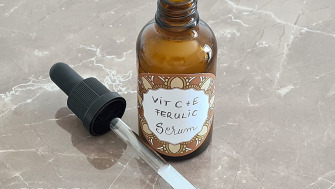
  • Sérums antioxydants intensifs (les célèbres sérums « CE Ferulic »).
  • Crèmes de jour et lotions urbaines anti-pollution.
  • Soins anti-taches et traitements éclaircissants pour la peau.
  • Lotions après-soleil pour réparer les dommages oxydatifs.
  • Produits de soin pour les peaux matures ou exposées au soleil.

Guide de formulation

  • Procédure : L’Acide férulique doit être préalablement dissous dans un solvant (tel que le propanediol ou l’éthanol) avant d’être ajouté au reste de la formule.
  • Stabilité : Sensible à la lumière et à la chaleur. Ajouter en phase finale, à froid (en dessous de 40°C).
  • Plage de pH : Optimale entre 3,0 et 5,5. Un pH trop élevé peut entraîner la dégradation et le changement de couleur du produit.
  • Synergies Ellemental :
    • Le trio d’or : Doit être combiné avec la Vitamine C et la Vitamine E pour constituer un système antioxydant puissant et disponible.
    • Protection : Une association intéressante se fait avec l’huile de Karanja et le Coenzyme Q10 pour protéger la peau contre les rayons UV.
    • Effet anti-taches : À utiliser en association avec l’Arbutine afin de cibler les taches pigmentaires sous deux angles différents.

Sécurité d’utilisation

Profil : Actif puissant, bien toléré aux dosages recommandés.
Précautions : Usage cosmétique externe. Respecter le dosage recommandé. Tenir hors de portée des enfants.
Conservation : Dans un endroit frais et sec, à l’abri de la lumière.


Références scientifiques (2022-2025)

  • Zhang, L., et al. (2024). Ferulic Acid: A review of its antioxidant mechanisms and synergistic effects with Vitamins C and E in skincare. Journal of Cosmetic Dermatology.
  • Díaz-García, C., et al. (2023). Natural phenolic acids as photoprotective agents: Focus on Ferulic Acid stability in topical formulations. International Journal of Molecular Sciences.
  • Murray, J. C., et al. (mise à jour 2022). A topical antioxidant solution containing vitamins C and E stabilized by ferulic acid provides protection for human skin against photoaging. Journal of the American Academy of Dermatology.
  • Sarkar, R., et al. (2022). Antioxidants in the treatment of hyperpigmentation: The emerging role of Ferulic Acid. Clinical and Aesthetic Dermatology.


Détails

Code
D-1377
INCI
Ferulic Acid
Index naturel
ISO 16128 - Origine naturelle 1.0
Additifs
non
Conservateurs
sans conservateurs
Apparence
blanc crémeux, poudre
Convient pour
cosmétiques, protection solaire
Principaux avantages
anti-rides, anti-âge, antioxydant, protecteur, tonique pour la peau
Indications spécifiques
rides, ridules, taches pigmentaires
Soin de la peau
Crèmes pour le visage, Crèmes pour les yeux, Sérums, Traitements
type de peau
Mature, Tous les types
Soins corporels
Crèmes Émulsions
Soin solaire
Crèmes, Produits après-soleil
Maquillage
Anti-cernes, Fond de teint
Stockage
dans un endroit frais et sec, à l'abri de la lumière directe du soleil
Download
SDS  |  TDS

Recettes avec ce produit

Avis

4.9 sur 5 étoiles
Basé sur 20 votes
5 étoiles
90%
4 étoiles
10%
3 étoiles
0%
2 étoiles
0%
1 étoile
0%
Possédez-vous ou avez-vous utilisé ce produit ?
Publier l'avis

Rédigez un avis et gagnez des points de fidélité d'une valeur de 0,40 €.

K
Kristiina Kutserova
13 sept. 2025
Achat vérifié
hope this message finds you well.

I am currently working with ferulic acid and would like to ask for your guidance regarding its dilution. Specifically:
1. Recommended solvent for dilution (e.g., propylene glycol) or somethink else.
2. Suggested dilution ratio to achieve a stable solution.
3. Optimal temperature for dissolving ferulic acid.

Your expert advice would be greatly appreciated, as it will help ensure proper handling and stability of the ingredient in our formulations.

Thank you very much for your time and support. I look forward to your guidance.
a
attilanicoleamanda N.
05 mars 2025
My order came today, but I haven't had a chance to use this ferulic acid yet, but I'm sure it's as good as all your products.
I
Irina A.
10 janv. 2025
I have used it in masks at the minute, dissolved in floral water or plain water, with oligo hyaluronic acid, or royal jelly powder. I've also used it just dissolved in plain water to notice the difference. It moisturizes, refreshes, tightens the skin, tightens pores.
A
Adriana U.
10 déc. 2024
A powerful antioxidant, excellent in neutralizing free radicals, protects the skin from harmful environmental factors, particularly useful in formulating anti-aging cosmetics, treatments for mature skin and sunscreen formulas.
C
Claudiu B.
10 déc. 2024
I've been using ferulic acid for a little while but I'm glad I discovered it. I recommend it in body milk, you can really see and feel the difference on the skin, same product, with and without ferulic acid.
G
Gabriela C.
10 oct. 2024
Cosmetics for people with mature skin should also contain an antioxidant that neutralizes free radicals and annihilates harmful environmental factors. Ferulic acid is a good antioxidant. I recommend it.
E
Estera E.
10 oct. 2024
I use it in vit c serum. it gives brightness and glow to the skin. Visible results after just a few applications youthful and radiant skin.
E
Emanuela G.
10 oct. 2024
It is a very good antioxidant, over time if it is not stored properly it will yellow the color. It is very difficult to dissolve in the third phase of emulsions and sometimes white particles of ferulic acid remain so it must be shaken very well
A
Alina B.
10 oct. 2024
Ferulic acid gives a cosmetic product anti-aging, antioxidant properties by neutralizing free radicals.Used for a mature complexion, it brings added value to a cosmetic formulation.
B
Blaga F.
05 janv. 2024
4 stars because I did not find on the website the recommendation to dissolve before use. It crystallized into an emulsion after a few days after preparation. 5 stars for how it feels on the skin after dissolving in propanediol. So I recommend it, with confidence, it is a valuable active!
A
Alina A.
05 janv. 2024
As one of the best natural antioxidants, obtained from plant sources, it has f good effects against wrinkles.
L
Lidiya D.
29 nov. 2023
Like kojacic acid, it perfectly fights age spots on the skin. I also use it for ferul peeling, cleansing the skin of dead cells.
M
Monenciu M.
05 oct. 2023
It is a valuable ingredient in formulas to protect and maintain the skin's healthy and youthful structure.
H
Heksch M.
05 oct. 2022
Indeed a remarkable antioxidant, it protects the skin and gives it a certain brightness and somehow health
L
Luminita A.
05 oct. 2022
Ferulic Acid is the must-have antioxidant in your daily skincare routine. Any woman concerned about the health and beauty of the complexion should know about this precious ingredient that helps you achieve a radiant beautiful complexion.
B
Blaga F.
05 oct. 2022
I can't give feedback about the effects on the complexion yet; I used it in a gel with aloe vera, it crystallized slightly.
A
Alexandra C.
05 avr. 2022
One of the ingredients of the Ferulic Acid serum,copy of the famous ferulic acid serum used by celebrities like Hailey Bieber. I am delighted with the results, sure to see measurable differences in a month or two. I recommend Ferulic Acid Serum.
A
Alina O.
05 avr. 2022
Since I discovered it, I add it in many products for its antioxidant effect. There is no complexion that doesn't need help against free radicals.
S
Semenescu I.
05 janv. 2022
I love it in combination with Vitamin C! I've been using it for a while now and haven't had any discomfort :) highly recommend!
C
Cristina Dan
15 avr. 2018
Hello, I would like to add ferulic acid to the vitamin C + hyaluron serum preparation, can you please tell me what percentage/gram I should use? Or, can you direct me to a preparation containing ferulic acid, ascorbic acid, vitamin E, vitamin A? Thanks!